Wild Edibles

28 Apr

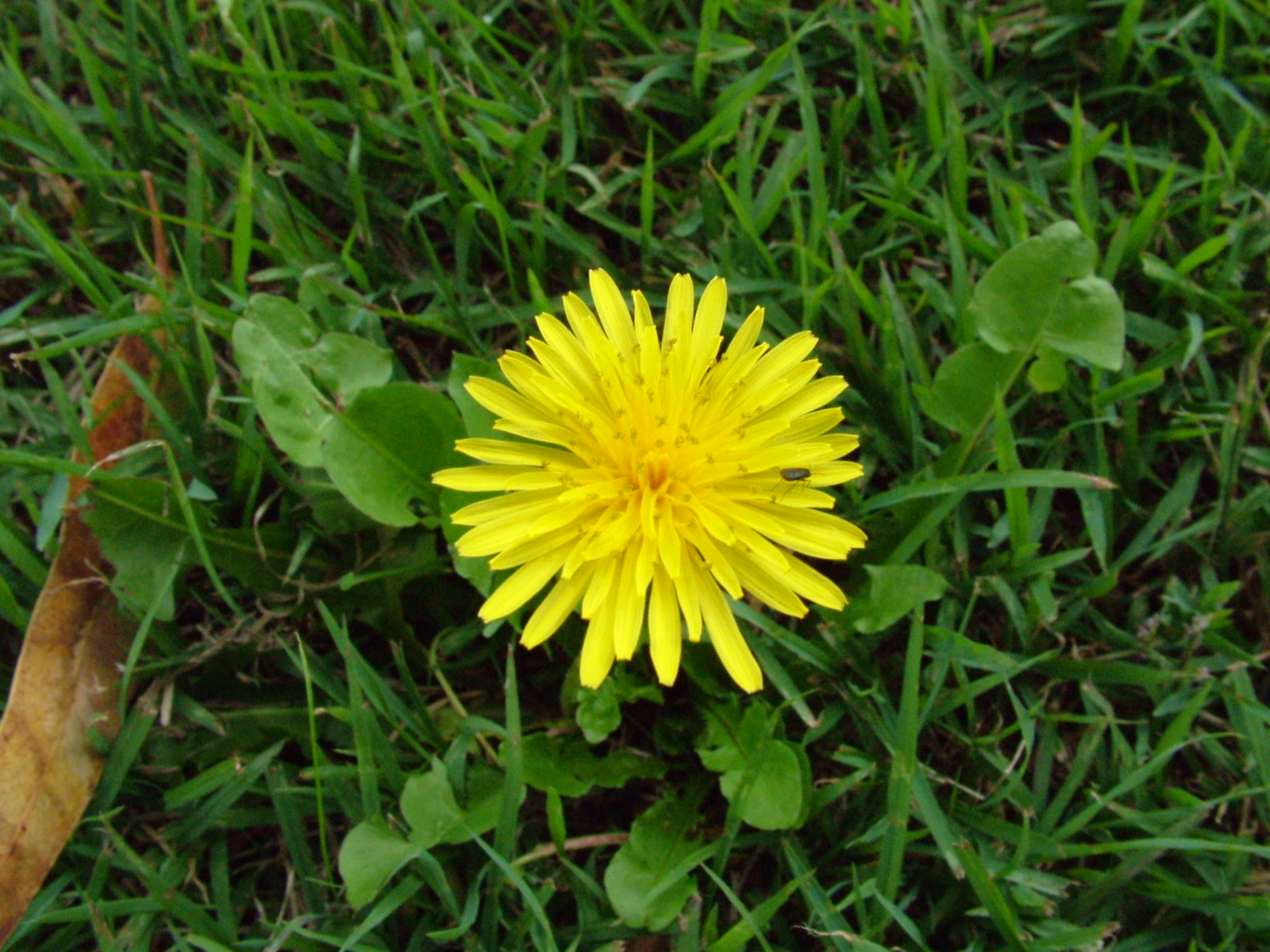
I’ve been watching Hugh Fearnley-Whittingstall a bit lately and he seriously appeals to me on many levels. There’s the simple back to basics cooking, his pragmatic approach to smallholding and the basic approach to start from little and building up a sustainable home. However, it’s his stingyness that has got my attention. A common theme in his TV shows is making a scrumptious meal from free ingredients. Sometimes these ingredients are wild plants such as wild garlic, nettles and dandelions. And some are wild animals such as river eel (caught in a trap with some road-kill bait), wild pigeon or deer.

Living in Sydney I dont have much of an opportunity to shoot wild deer and I’m 100% positive I’m not going to eat any urban pigeon even if I could catch them so that leaves me with wild plants. Over the last few weeks I’ve been doing some research into wild edibles, ranging from native bush foods to non-indigenous edible weeds, that’ll no doubt be a focus of a few blogs, but for now I wanted to a) highlight a few people that are doing great things in this space and b) ask the question from my readers what / how / why they seek out wild edibles.

So objective A.

I’ve come across 2 folk that are doing great things promoting wild edibles. One in Melbourne one in Sydney.

In Melbourne there is Doris Pozzi who was recently written up in the Melbourne’s Age. She has written a book that I’ve got on order that highlights the top 25 edible weeds in Melbourne but are equally relevant to the other regions of Australia. She also runs a great web site “Edible Weeds” with interesting facts and information that will help the novice forager on their journey.

The person in Sydney was given to me by Doris. Diego Bonetto (Twitter @theweedone) and while I’ve only just started digesting his information on the Weedy Connections website I’m amazed at the incredible Weeds database he has pulled together. Sort by location and get information on all the weeds in your area. He has details on the medicinal uses and culinary potential as well as some great botanical information. Well worth the look.

Both Diego and Doris run foraging tours in Sydney and Melbourne respectively. I’m going to try and get to one if not both as soon as possible.

And now for objective B. Do you use wild food? How have you experimented and used wild food? Wild food to me range from the common nasturtium and dandelions to the more exotic and rare. I’ve tried a few times now to harness the delectable aroma of the monstera deliciosa as a sumplement to my fruit bowl but haven’t yet nailed it. I’ve also started collecting dandelions to make a dandelion marmalade.

Would love to hear your stories!
Can there be too much politeness?

28 Mar

We often hear stories about the demise of a polite society as we are rush to achieve our life goals at the expense of others so this post might seem a little out of place but bear with me here.

To put it in context I catch a Sydney Ferry to work and for those people that haven’t experienced this delight let me tell you it’s near on THE best way to go to work. The humdrum of work is a distant thought in the morning and forgotten on the way home. Passengers are nice while waiting for the ferry as they orderly line up and allow bicyclist and older people on/off first. There’s polite quiet as people contemplate the view down Sydney Harbour. And they are even nice as they climb aboard the connecting bus. I have seen a number of things that have made me smile such as the ferry ticket collector drumming up support for the school kids to sell their charity chocolates (the kid had completely sold out before even getting to school) and has been echoed by a bus driver. In that case the driver got up before we departed and announced that she loves that route because everyone is so friendly and it makes a great start to her day.

So it’s better than the soulless bus or train I hear you say, so what? Stop rubbing it in. But is it possible that too much politeness actually becomes tedious and embarrassing? I’d like to think not but as I disembark in the afternoon almost every single passenger thanks the talented crew member who rarely fails to throw the rope around the bollard. It’s almost as if that single act has ensured that work is left behind and we are now “home”. The crew member politley says “thank you”, “have a nice day”, “see you later” etc and I often wonder that after 200 odd people have left the ferry all the way up the river he’s probably over being polite.

I certainly hope not and sincerely hope they get home themselves with a big smile on their face knowing they’ve helped so many people get home!

When are egg’s like witches?

16 Mar

If you are like my family and end up with ageing egg’s in the fridge then this <probably very well known> trick will help. We end up with ageing egg’s for a number of reasons, not always because we don’t eat them fast enough, sometimes because both my wife and I will have a hankering for eggs and within a day of each other buy a carton or 2.

So what do ageing egg’s and witches have in common? In the not-so-distant past people charged with being a witch were thrown into the local river with stones tied around them. For the poor souls that sunk and drowned they were given a proper burial and a big apology. However, witches, apparently because they are made of wood, would float in the river, in which case they were hauled out and burnt at the stake. Rough deal either way in my opinion and a cynic might suggest it was nothing more than a land grab. “Hey I saw my neighbour talking to cat – She’s a witch”, “Good job, either way you can have her land now”.

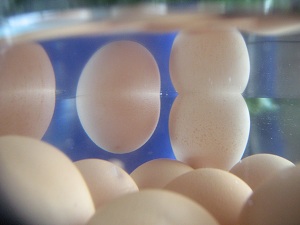
Floating EggsBut egg’s? Well, if they if act like a witch and float then they are obviously no good. I’m not suggesting you cook them up on some steak (yeah bad pun I know) but I’d certainly throw them out. They are off and will probably make you sick – more on that in a tick.

If egg’s sink then they are all good. And rather than give them an apology I’ll fry, boil, poach or otherwise scramble them! Maybe with some thyme or paprika to cleanse their soul.

My understanding of why this happens is quite simple. Egg shell’s are permeable, meaning they let air and out albeit quite slowly. An egg that has been in your fridge for too long will have absorbed enough air to both make it float but also send the insides off and should be discarded.

Floating EggsThe last time I put this test to the test I had my camera and for me it’s the photo’s rather than the story / science / witch-folklore that is interesting.

How else can you tell an egg is off? Love to hear any other tricks you use!

Chicken Cacciatore

14 Mar

Since the birth of 2nd child and daughter I’ve been looking for recipies to cook enmasse so I can freeze them up and eat during the week. Something that popped up was Chicken Cacciatore. I’m not going to go into a blow by blow of how to cook it (there’s a fair few of those already) but wanted to share an interesting tidbit.

Cacciatore means “hunter” in Italian. This is a throw back to the fact that this meal is a hunter’s meal in that they grabbed whatever meat they had (chicken/fowl for instance), threw in any handy vegatables or herbs and cooked it up. Slow cooked if it was a gamey meat and with some wine given they are Italian, my sort of meal.

What’s also interesting is that the type of wine used depends on the region of Italy. White in the north and red in the south.

For this dish I’ve used a “liberal” dash of red wine, home grown fresh rosemary, home grown fresh bay leaves (yeah I know, a little French) and some dried oregano. Vegetables include carrots, celery, onion and garlic. All served up with some rice….did the Italian’s use rice? How else have you cooked up this Italian stew?

Swap Shuffle Share.

24 Feb

A while back I caught wind that a new site was about to be launched. It attracted me because it was all about taking a local idea around gardening and sustainable food to all of Australia. As you know I’m all for anything gardening….urban, backyard, guerilla, sustainable, vegetable or fruit (just not flowers and ornamental, waste of good space IMHO). So when someone gives me the option to connect, share and swap excess backyard produce I was keen to get involved.

Swap Shuffle Share was launched on Australia Day 2012 with a whole bunch of teaser’s on Facebook and I’m glad to say the site has launched well with a growing following and all the feature’s you’d want from a social site. The FB page topped 1000 likes before launch and has steadily grown to just over 3000 likes in less than a month.

The site is the genesis of Natasha Kuperman. She describes herself as “keen novice gardener with an unruly backyard”.She wants to build communities to support and connect people with the aim to avoid the frustrations of growing your own food. It’s great that she’s both a keen gardner and sharing the experience with her kids who “squeal with delight” when they uncover a strawberry. From what I can gather she has started a local food swap group in her area and figured there’s appetite (pun intended) around Australia, hence the site.

The site has all the features you’d expect from a social site including the ubiquitous activity stream, friending and communities. What you don’t always see that I particularly like is the “visit” feature, which is a simple way visit a random group or person. It’s similar to twitter’s “discover” but being local feel’s much more real and connected.

The groups or communities range from generic to specific and as expected it’s the generic that have the most members. Frugal Gardening tops the list with Cooking / preserving & permaculture not far behind. The more specific communities are largely around local area’s such as rural NSW and Tassie. My personal favourite is the “Worms, I got em” because I “got em” and I “love em”.

Outside of the communities there are forums. We don’t usually see these on social sites however forums real benefit is bridging the gap between the fleeting activity stream with the more permanent (and largely non-social) blog topics. Forums provide a semi-permanent discussion board to continue conversations that might be lost in the activity stream. One downside to the forums though is that they are disconnected from any associated communities / groups. Linking these somehow would enable users to raise awareness of conversations happening outside of the community.

The site also has a directory of relevant topics such as member blogs (like mine), local food swaps & community gardens. There’s also an events page that is member driven and displayed chronologically. This could be quite a compelling aspect of the site if it hits critical mass.

So what’s the verdict? It’s a great site with noble intentions. I’d personally love to see it gain in popularity and become a single resource for urban and sustainable gardening and most importantly, sustainable food. However it will suffer without a critical mass so it’s good to see a multi-channel marketing approach across Facebook and Twitter.

If you haven’t already, check it out and join the “Worms, I got em” group, cause really, you should!

Hand pollinating passionfruit.

4 Feb

A while back I posted my research on the passiflora and the passionfruit plant. And after about a year of growing in pots and transplanting to the garden I have a great vine growing now. More to come on that progression but for now I’ve been doing some reading on hand pollinating the passiflora to help it set fruit.

The passiflora has both male and female bits however they need to be pollinated from different flowers. The flowers can be from the same plant for most of the passiflora family. My notes are focussed on the Passiflora Edulis (or common purple) variety.

To hand pollinate you first need to know a thing or two about plant morphology (just a fancy word for what bits do what!)

Here’s a quick run down on the flower parts for reproduction aka fruit making are:

  • Stamen – the full length is called the stamen with the anther on the end that contains the pollen. On the passiflora there are 5 of them (believed to represent the 5 wounds of Christ)
  • Carpel – on the passiflora there are 3 (believed to represent the 3 nails used in the crucifixion) and their job is to collect the pollen. They do this through the commonly known stigma on the end of the carpel. The stigma collects the pollen, runs it down the pollen tube (known as the “style“) and into the ovary. Just like humans, it’s the ovary that’ll turn into a baby, in this case a passionfruit!

So with that easy bit of information, how can we hand pollinate a passiflora? Easy!

  1. Clip the anther’s off the end of the staman
  2. Using your hands or a brush, rub the pollen onto stigma that’s on the end of the carpel
  3. Done!
While handpollinating seems straight forward there’s a feature of the passiflora that throws some complexity into the mix. In the early 20th century rich and famous women wore the passiflora flower as fashion accessories. They are quite an attractive flower but what probably made them more attractive was that they only flower for 24hrs. Open, pollinate, close and wither! 
While this exclusivity made it a fashion favourite it obviously plays against us handpollinators. If you have a large vine you should fine with a few flowers open each day but for smaller and less mature vines you might need to either watch the vine every day or collect the anthers. I can’t find anything specific on the passiflora but I’d suspect the pollen will last 24 – 48hrs, maybe more if you keep it chilled in the fridge. Let me know if you do any experiments on keeping pollen. 
I hope that helps get you more passionfruit set. Have you had to hand pollinate your flowers? Any tips you can share? 

Japanese tea pot

19 Jan

I love tea. I love all sorts of tea but I tip Japanese green tea (sencha) as my favourite, followed closely by genmaicha (Green tea and brown rice). For Christmas a few years back my auntie bought me my first tea pot  and it really saw some use. I’d make a pot of green tea a few times a week and sometimes a few pots a day. So when my floral English style tea pot broke I needed to replace it, fast!

I’ve have quite an affinity with all things Japanese so I thought a Japanese tea pot was in order. There are a few different types. Roughly there is the Tetsubin (te-tsu-bin) which is your regular shape with a handle over the top and it’s made of cast iron. According to wikipedia the tetsubin is appreciated as a source of iron as the iron leaches into the water…wow.

The more common type is the Kyushu which is made of ceramic and is either the regular shape or has a protruding handle out the side. This is the type I opted for when I wandered into “Japan City” at my local Westfield that was having an opening sale! $38 and I’ve got an elegant, traditional style tea pot that’ll be sure to impress.

I’m really happy with it. It pours well. It’s deceptively large and I can get 2 regular size tea / coffee cups from each batch. I’m still using a tea infuser inside but it’d be fine with uncut tea leaves.

I’m aiming to never wash it. Just like a wok, your tea pot will season. I’m sure there’s 100 year old tea pots out there with a rich heritage of flavours built up over the years!

Do you use a tea pot? What sort? Anything you can share about choosing, using or caring for it?

Pickled Limes

12 Jan

My passion for pickled foods started with chilli. I was never very good at eating hot food but I could see that people could be very passionate about hot food. So I went out to teach myself to enjoy the good spice. During the journey I found pickled limes(with chilli) at an Indian restaurant and instantly fell in love. I started buying pickled limes from the supermarket and eating them with cheese and crackers (a taste combination I highly recommend). One day I saw limes on sale and thought I’d take a stab at making my own. I was successful and now anytime I see limes on sale I grab a bag and pickled them up with various flavours like rosemary, sage, thyme while ALWAYS making sure there’s a liberal dose of chilli’s.

Do you know the difference between pickling and preserving? Pretty simple, pickling something is just preserving it in brine (salt).

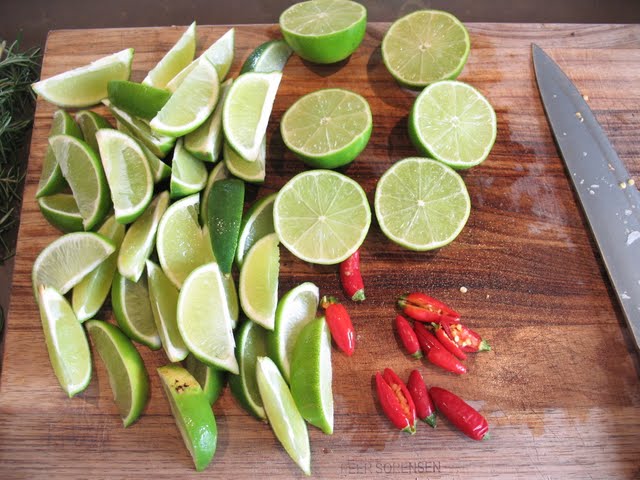
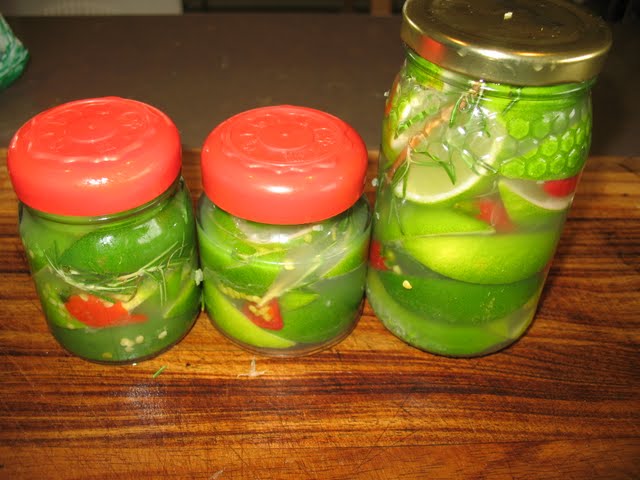
As always, to get started I organised my ingredients. Today I decided to go with rosemary, mainly because it’s growing great in my garden at the moment. I picked up 4 limes for $3 so given that I already I had the salt and the rosemary and chillis are from my garden this cost me a little over $6. As you’ll see I ended up using 1 big jar and 2 smaller mustard jars, all of which I boil in water for about 15min to sterilise.

While the jars are sterilising I chop up the ingredients. The limes I divvy up between slices for pickling and halves for using the juice. The chilli’s I chop in half and gently smash, the rosemary I leave as is.

Once the jars are sterilised it’s simply a matter of shoving the lime slices into the jars interspersed with chilli’s and rosemary twigs. I add a good pinch of rock salt between each level of limes. I don’t think you can overdo the salt at least I haven’t yet, but you don’t need to go nuts.

When the jar is full I squeeze in at least one lime depending on the size of the jar. Normally about 1/3 of the jar is enough. Then I top it up with freshly boiled water and give it a shake to get the bubbles out. Before I put the lid on I put a piece of squeezed lime skin side up on top. This keeps the slices submerged and covers everything (I discard it when I eat the limes). I try and top the liquid up right to the top before putting the lid on.

The last step is to clean it out and submerge the jars in boiling water for about 5min. Really not sure what this does but it’s a common step I’ve read with all canning / preserving / pickling techniques.

That’s it. Let it sit for 2 – 3 months (mine have been fine up to about 6 – 8 months) and enjoy.

Tip though, you eat the skin not the flesh. The flesh will taste horrible like really salty off lime. Remove the lime slice, skim the flesh off and chop up the skin. Use it as a side pickle for an Indian curry or as I said before, eat it with cheese and crackers.

Last tip, the process is exactly the same for lemons. I make those up and use them in Moroccan dishes like preserved lemon and chicken tagine and olives!!

Keep in mind that it’s very important to use sterile equipment, jars and of course your hands. The salt will go along way to keeping the bugs at bay but you need to be careful. If when you open the jars it doesn’t smell or taste right, don’t eat it. It’s not worth the risk to get ill (or worse) from botulism.

Home-minced home-made pork, sage & garlic sausages

7 Jan

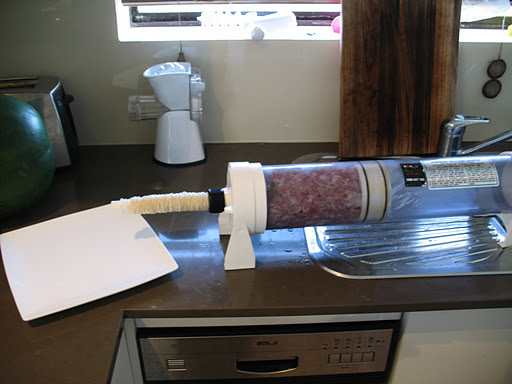
Last year something inspired me to make my own sausages. Subliminally I might have been influenced by the NIB summer commercial “I love sausages” however I’m sure it was just part of my learn to cook and be self-sufficient craze. In any case, and despite many raised eyebrows from friends and family, I eventually bought the “Dakotah Sausage Stuffer“, a 4kg water-powered meat pushing beast of a unit (and a massive space filler in the kitchen cupboards).

It took me a few attempts to get the technique sorted and buying the right parts (hoses, nozzle attachments etc). The most recent acquisition to make my sausage making experience easier was a mincer. Up until now I’ve used a food processor that just didn’t chop the meat fine enough, ending up with largish chunks of fat in the sausages, not a key feature found in the worlds best sausages, so the mincer was on the Christmas list. I scored a Chef Avenue Wonder Mincer ($49 from King of Knives).

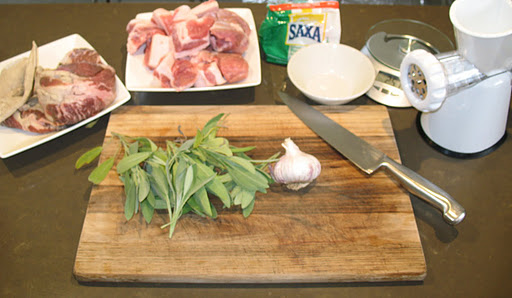
I decided to go with a simple recipe to start with, the old favourite Pork and Sage, and because there’s nothing garlic doesn’t go with I added garlic. On the left you can see that there’s also some beef and beef fat. A lesson learnt (and researched) is you need to have about 30% fat. That seems a lot but being dry doesn’t make the top 10 best sausage feature list! I didn’t end up using the beef fat as the pork fat was enough.

Once I had all the ingredients ready I chopped up 10g of sage, crushed up 25g of rock salt, 3 cloves of garlic and trimmed the fat off the 1.3kg of pork so I could measure the fat ratio (ended up with approx 400g of fat which is 31% of total meat).

Next step was to mince the meat in my brand new mincer. There was a little apprehension that the cogs were plastic and I really had no idea how hard it was going to be. Surprisingly it was very very easy. The cogs work so there’s really very little pressure required. The trick however was to ensure the bits of meat were small enough to fall into the spiral pusher-thingamajigit, too big and they got caught and needed to break before continuing towards the blades.

I added the salt / sage / garlic mixture to the mincer but in hindsight I’ll just mix it in by hand because I lost too much inside the mixer.

Once mixed through I shoved the mixture into the 4kg water-powered sausage stuffer, attached the nozzles, slid on the sausage casings (I’ve used natural collagen casings) and powered the beast up. With minimal effort out spat my snags (image on left). Using my yet to mastered skills of turning the sausages (alternate clockwise / anti-clockwise) I ended up with something resembling sausages you might buy from your local butcher! (image on right)

All up it took me about 2 hours to prepare, mince, make and cook the bangers however you definetly get economies of scale the mince you create.

To re-cap the ingredients I had:

  • 1.274kg Pork including ~400g fat
  • 10g Sage (home-grown)
  • 25g rock salt
  • 3 cloves of garlic

Total cost $18 keeping in mind that I know exactly what’s in these snags. I could buffer it out somewhat by adding bread or other fillers but for the time being I’m happy with pure meat snags!

What did they taste like? Best I’ve done so far I’d say. Perhaps a little salty and a lot of fat rendered in the fry-pan so I could probably cut back on both those. Experimenting and learning is most of the fun!

What do you think? Would you spend the time with home-made sausages or do you trust your local butcher to use quality ingredients.

Sprout me.

21 Sep

This is too good not to share so I’ve returned from the long winter to blog gardening again.

How clever can you get to make a attachment that waters your garden using any old bottle available (any bottle yet to be confirmed).

Get (not alot more) information here! If you are going to order one let me know and I’ll chip in for an extra 1 and shipping!