The communal Botanical Gardens of Sydney!

12 Mar

I took my visiting US relatives to Sydney’s Royal Botanical Garden today. Lovely piece of land championed by Mrs Macquarie (Governor Macquaries wife) due to her love of structured parklands.

A bit of history is that they knocked down a bunch of houses, bakehouses and boat ports to clean it up in 1807. Interestingly it was built alongside Hyde Park because Hyde Park was for walking whereas the Desmene (Domain) was not. Sounds like he wanted a grand lavish park all for himself and his wife!! This argument is furthered by a decree from Gov Macquarie in 1816 that people should stay out of the garden else punishment will be “inflicted on some idle and profligate persons”. Turns out that that warning wasn’t for “proper people”. These day’s the punishment is against the unwitting folk who venture to the Palm Grove cafe for a quick bite to eat. I paid no less than $11.70 for a meat pie and cola!! Highway robbery in the 21st century I say! However, enough lamenting the injustices against the common folk by the rich!

The garden has some great parts that I haven’t visited for a number of years. There are 100+ year old fig’s and some neat feature gardens. Of excitement was the masses of bat’s roosting in the tree’s, a much more “real’ bat experience then our recent trip to the Australia Reptile Park that showcases 8 bats in a small cage, but I digress again..

Another feature of the Botanical garden and the purpose of this post is the Herb garden . Situated on the south western side not far from the Conservatorium of Music there is a great selection of herbs from Australia and other parts of the world. It’s a treat to walk around and sample so many different kinds of herbs, some of which are for culinary purposes while others are ornamental or simply for fragrance. The Thai Basil took my award for most alluring while the “surprise award” went for the numerous varieties of Lavender (Lavender cotton grass took honors in that category).

A few years back in my pre-gardening days I wandered through the herb garden with my now wife. We were both amazed and shocked that there were a number of people walking through the garden putting more than a sample in their collection bags, presumably for their upcoming dinners. Is this OK? Are the Botanical gardens for the people? When does a showcase garden turn into a communal garden? In my mind I’d say when said pilferers help maintain said garden. But is that the case? Perhaps I should look up Adam Smith’s thoughts on common property, perhaps those pilferers should as well. 🙂

If you have the chance, get down to Sydney’s Royal Botanical gardens. Give yourself a day to wander around, take a packed lunch and enjoy the oldest structured garden in Australia.
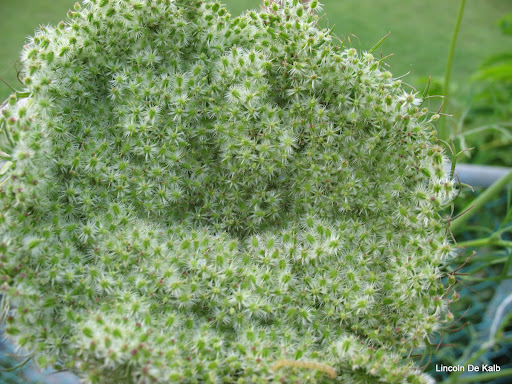
Update on carrot seeds.

12 Feb

A while ago I posted that one of my dragon carrots had bolted to seed. I let it go as a bit of experiment, but a few weeks ago I realised that the seed heads where overrun with aphids. This gave me 2 opportunites for blog posts, one to answer the question “what happens to a carrot when it goes to seed” and info on aphids. First up the former!

The carrot stalk ended up about 1.8m tall with approx 6 flower heads of varying sizes. Over time the heads folded up and the seeds started browning up. I cut the first and biggest flower off before the aphids got it and they are now drying in a paper bag (another future post because I’ve used the same technique with coriander). Here’s a close up the flower, unfortunately the camera was on a trip with my wife when they went brown and aphid infested so I no photo’s of that sorry.

Something interesting I noted that I need to research some more is that the other carrots still growing where small and slow growing. I wonder if the carrot that’s gone to seed somehow affects those around it? Survival mechanism perhaps so it’s seed will have somewhere to grow when they dry out and land? Not sure about that.

But what happens to a carrot that goes to seed?

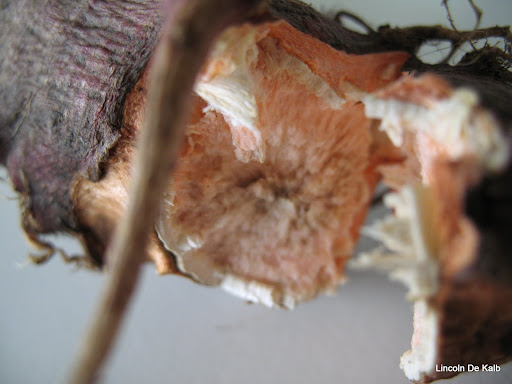
When I first dug it up and washed it off it looked pretty much like a normal carrot. Even where part of the skin seemed to split away it looked like a soft fleshy carrot inside.

However when I touched the inside orange flesh it was hard. My fingernail couldn’t dint it. It had turned very woody.

After a day or so on the kitchen bench it dried up considerably and was quite light for it’s size.  Here’s a few pic’s of when we snapped it take a look inside.
You can see how it snapped like a stick. The edges look sharp but are in fact almost soft. The lightness and texture reminded me a lot of balsa wood but it felt stronger. Might make for a more durable balsa wood airplane. 🙂
This experiment has answered the question that you definitely cannot eat a carrot that’s gone to seed and provided me with a bunch more topics for posts. Hopefully the seeds I’ve harvested sprout and I didn’t let the biggest carrot go to waste.
Stay tuned! 

Powdery Mildew

22 Jan
A common complaint that I’ve seen on various forums is white powdery mildew. It can affect a wide variety of plants including grapes, strawberries etc but the questions mostly enquire about their squash’s and melons. Indeed my zuchinni, cucumber and rockmelon (cantaloupe) plants all have this condition which is what started this research topic.

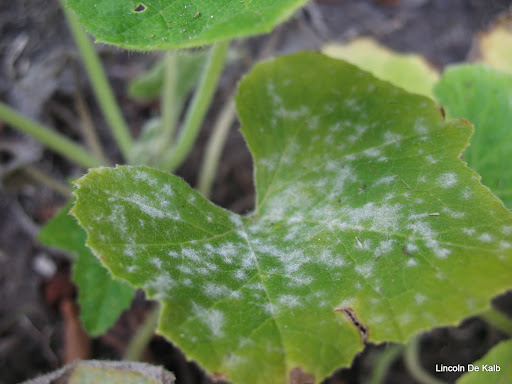
Zuchinni with powdery mildew
While it’s commonly referred to as white powdery mildew is can come in white, brown or grey. It’s caused by a few different types of fungus all from the Erisyphales order  for those botanically minded folk. It seems that specifically my garden has Podosphaera fusca which according to Wikipedia affect curbits (cucumbers, squash, melons etc). The picture on the left show’s prominent vibrant mildew clusters.

Powdery mildew is primarily caused by environmental conditions such as high humidity, not enough sun etc. If possible try and get the affected plants 6 hours of good solid sunlight a day. Saying that though it hasn’t helped my rockmelon which get’s full sun all day.

Other treatments that I have found are your usual supects of fungicide and store bought chemicals which I’m not a fan. An organic treatment that I am using and it looks to be working is milk. Good old fashion cows milk has natural anti-bacterial agents called lactoferrin. Lucky for us these agents aren’t detroyed when milk is pasteurized.

To spruke some of the antibacterial benefits, lactorferrin is produced commerically as an over the counter supplement for athlete’s foot, yeast infections and for athlete’s to boost their own immune systems while training. Lactoferrin is in highest concentrations in human breast milk but also in small quantities in cows milk and, would you believe it, tears and nasal secretion.

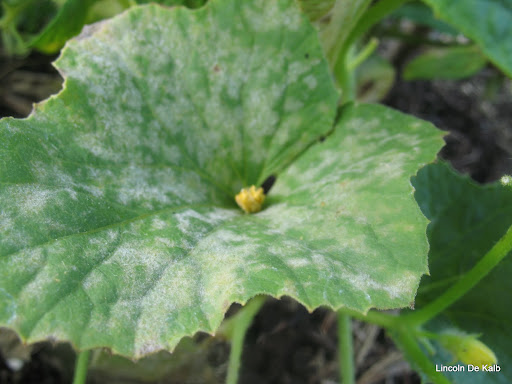
Zuchinni with powdery mildew
after a milk spray.
I haven’t tried sneezing or crying on my plants but I have sprayed them with the recommended 1 part milk, 9 parts water a few times with ongoing success. If you use skim milk there’ll be less fat in it to go rancid but I haven’t had a problem with this. Make sure you spray under the leaves as well as the fungus is on both sides. Compare the picture to the right with the one above. You can see the fungus is less distinct and starting to fade. This is 2 weeks after the initial spray with a follow up spray a week later.
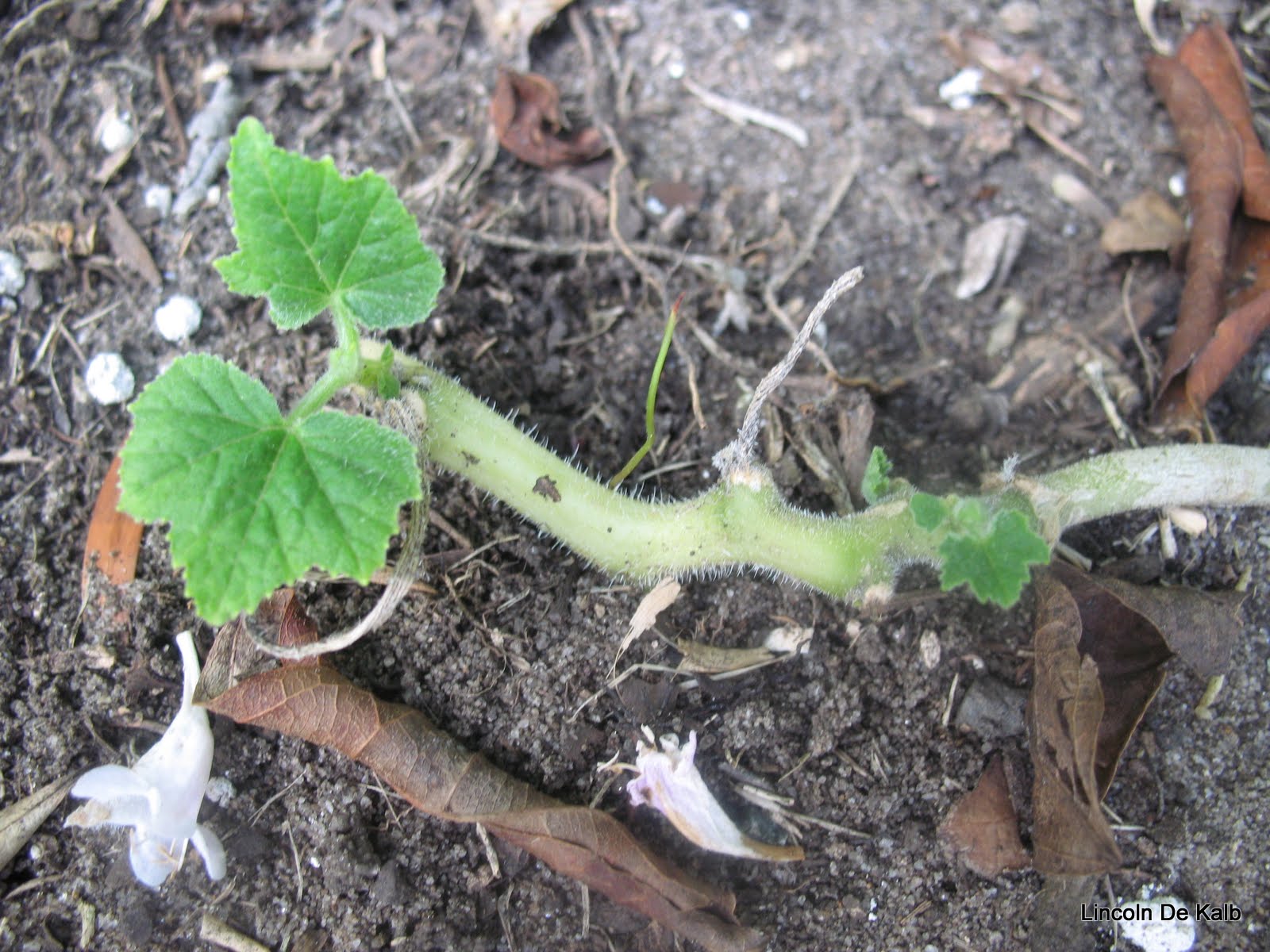
Zuchinni new growth after
2 weeks spray and cut back.
I trim back the badly damaged leaves before spraying. This will allow the plant to spend it’s energy on the parts that are savable. New growth should bounce back once the fungus isn’t sapping the energy from the plant.
Zuchinni new growth after
2 weeks spray and cut back.
Other organic solutions for powdery mildew that I’ve seen but not used include:
  • Sodium Bi-carb – up to 10g in 1litre of water. Carefull though as too much will burn the plant.
  • Liquid Seaweed – a great fertilizer which will help the plant fend off attacks but sometimes too much fertilizer can cause the powdery mildew in the first place.

Have you tried milk or any of the other solutions? Have you any other ideas? Would love to hear about your stories battling this very common problem.

What’s in a trellis.

10 Jan
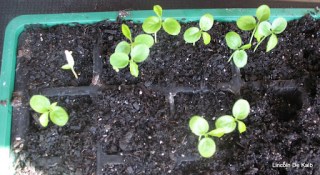
I recently borrowed some seeds from a fellow gardening freind, Andy. Among them were purple beans, peas, corn and butterlead lettuce. All have sprouted nicely in my seed raiser but I was stuck with how I was going to grow the climbing beans and peas. I had an option to ask the neighbours if I can run them up the shared fence but I was concerned that all the beans would grow on their sun filled side of the fence. So I decided to build a trellis.

From the ancient Indo-European word “trejes” the word trellis is related to the english word “three”, “trio”, & “tripod” as well as non-english words for three such as tri, drie etc. Trellis actually means something made of “three threads” though these days trellis’ come in all sort of shapes and sizes.

And to keep the three theme I decided to plant my new seeds in the “three sisters” approach. This is a native american style of growing the three staples, beans, maize and squash (though i’m using rockmelon). These three plants form a symbiotic relationship in that the maize provides something for the beans to grow up removing the need for poles. The beans lock the nitrogen in the soil helping all plants. Finally the squash provide a ground cover or natural living mulch to keep the weeds away.

Below are the various styles I found while looking for solutions (my graphic design skills were severly tested!)

Firstly, the traditional 3 pole teepee style (left). This consists of three bamboo poles lashed together at the top and thread (twine, wire etc) run betwen the legs. The lashing on the top doesn’t have to be fancy, it just needs to be solid. A downside to this style is that if you have very bushy plant growing you will struggle to get at the beans on the interior.

Next is the 4 pole teepee style (right). Similar to the 3 pole variation but you can leave one side free of threads allowing you (or the kids / pets) access to the interior to play, pick the interior beans, get out of the sun etc.


The next variation is a little trickier but scales well for large plants or gardens. It’s known as the A Frame. If the poles are tall enough it’s conceivable you could get inside but but the main benefit is that you need more space you just build another A and run beam across the top.

Finally the simplest solution and the one I used is the straight up and down. 3 or more poles hammered into the ground and string run between the legs. This isn’t very stable so the legs need to be hammered in deep. I’ll see how this goes and

report back.

With all the styles plant the seedings around the base of the poles. You might need to loosely tie them to train them towards the string but after that they should find their own way.

Have you built your own trellis? What style? If you have any tips please send them through. Love to hear what worked and what didn’t.

Growing Passionfruit.

6 Jan
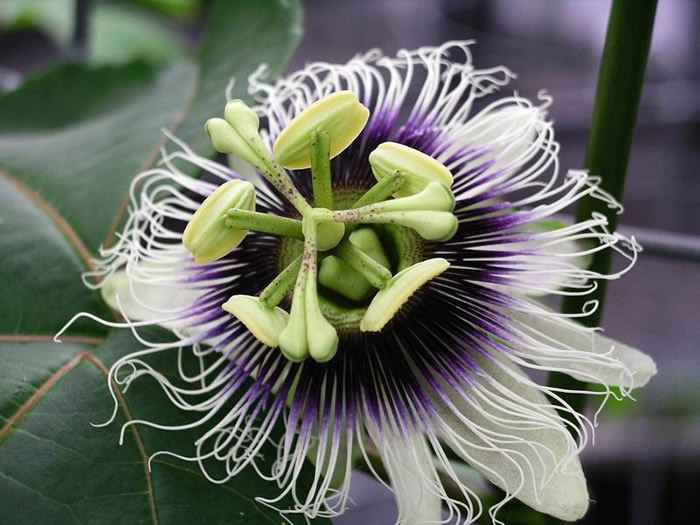
Image from Wikipedia

I’ve always loved passionfruit. There’s something about getting a cold spoon dug into the centre of a passionfruit, grating it up the side to get all the seeds and savouring the chunky sweetness. So with my garden going well and my understanding that passionfruit vine can be planted all year round I thought I’d give it a go. I’m going to put them in my garden as well “strategic” places around the neighborhood. 🙂

The passionfruit is the fruit from the passiflora vine. There are over 500 types of passiflora and while not all varieties produce edible fruit their spectacular and diverse flowers have been sort after throughout the ages, partly because for most varities the flowers only last a single day!!

In Australia we tend to get the passiflora edulis, P. Edulis, variety, specifically the Black Magic variety. P. Edulis come in two colors, purple originating in Brazil, and yellow, also known as the tropical passionfruit with an unknown origin.

Passiflora vines a very fast growing so need alot of nutrients. In the old days the plants were planted with a liver or ox heart in the soil to provide lots of iron and other nutrients. The vine will climb over anything near by so many gardeners will train it up a trellis or fence. For best results train the vine to the top of the fence / trellis first and allow it expand out. P. Edulis can grow 4.5m – 6m per year and will live for about 5 – 7 years. Give it a major trim every 2 years and overall keep it thin else it may develop bacteria and fungal problems.

In Australia expect a crop between July and November and then again in Feb to April. Though I’ve read in environments it will fruit all year round. This is the kicker for me, a good healthy vine will take 12 to 18 months to fruit! Grrrr, so my seedlings have a while to go.

The fruit is very high in beta-caratone, potassium and dietry fibre. Let the fruit go a bit wrinkly before you eat it as this allows the sugars to condense and provide a stronger flavour. My mother-in-law says you can freeze the passionfruit whole until you want to it use. Let me know if you’ve done this.

The flower has alot of history. In various countries it’s known as Christ’s Thorn (Spain), Christ’s Crown and Christs Boquet (Germany). What’s all this reference to Christ I hear you say? Well, the catholic missionaries saw many religious connections to the flower. An extract from this Wikipedia article helps explain the connection:

  • The three stigmas were to reflect the three nails in Jesus‘s hands and feet.
  • The threads of the passion flower were believed to be a symbol of the Crown of Thorns.
  • The vine’s tendrils were likened to the whips.
  • The five anthers represented the five wounds.
    Image from Wikipedia


  • The ten petals and sepals regarded to resemble the Apostles (excluding Judas and Peter).

A few other uses for the plant:

  • It’s suggested that it has antidepressent properties however most of these compounds are in the leaves. This might explain why some cultures smoke the leaves.
  • Both the fruit and leaves are said to lower blood pressure.
  • In Mexico the fruit is eaten with chilli and lime. I’m very keen to try this combination. Sounds a treat.

Finally, to harvest the seeds (as I did from a store bought fruit), simply open it up, put the seeds in your mouth and suck the pulp off, wash them off and plant them in a seed raiser. 

I apologies for the images from wikipedia. I’ll update them with my own once my plants start growing.

Sexy Carrots

31 Dec

For the last post of the year (Merry Xmas and Happy New year to y’all) and while we continue on the carrot theme here’s a pic from my a freind of mine. Let’s just call it “Matt’s carrot”.

Carrots too young to seed?

22 Dec
One of my dragon carrot’s has gone to seed. It’s shot up a 1.5m stalk and has about 6 clumps of flowers growing on it. Logic tell’s me to wait till the flowers / seeds start turning brown and chop them off the plant.
However I did a bit of digging around and strangely enough carrot’s are biennial and therefore aren’t supposed to seed till the 2nd year of their life?? These carrot’s are only 6months old so not sure what’s happening. Perhaps because their an heirloom variety they seed early? I can’t find any information specifically for Dragon Carrots.

Many sites I checked out suggested that you should only save the seeds from the first 2 flowers to sprout as these will produce the biggest and best carrots. Also to ensure genetic diversity, and good produce, you should collect from 40 or so different carrots. That’s going to be hard given I only have about 10 in the ground and I want to EAT them. Which does ask the question, what happens to the carrot when it goes to seed? Can I still dig it up and eat it? Does it lose flavour / color / shape?

I’ll post more as I know.!

Zucchini, Squash and Courgette

20 Dec
The difference between these has always confused me. I kinda knew that courgette was the french word for zucchini but where in the world did squash fit in. Squash was made even more confusing because the English call pumpkins squash.

A few months ago I planted some Yellow Straightneck Zucchini from seed and it really hasn’t gone all that well. Especially compared to the plants growing at a friends place I visited on the weekend where they are inundated with zucchini’s. Turns out that there are male and female flowers and that they had to manually pollinate the female using the male. Luckily we had this conversation before the 2nd bottle of wine was opened. 🙂

On the back of that conversation here’s my few hours worth of research.

Zucchini is the Italian name for a type of summer squash. Folks in North America, Australia and Germany use this. In France, Ireland, UK, Greece and New Zealand it’s known as a courgette.

A summer squash (cucurbito pepo) differs from a winter squash (cucurbito maxima or cucurbito moschata) in that it’s picked when it’s immature (the skin is tender and edible). Winter squash, such as pumpkin’s, are are mature with ripen seeds and a hard skin.

Here a good site listing the types of summer squashes if you want to know the different types. Something I learnt from this site is that my Yellow Straightneck Zucchini is open-pollinated, meaning that it needs to be pollinated from other flowers. I thought it was an heirloom variety.

Open pollinating fruits need female and male flowers. Female flowers have a baby zucchini below the flower while the male is just a flower. Normally bee’s or the wind would pollinate the females but I think I’ll need to hand pollinate. Once you pick the male flowers and pollinate the female the male flower can be stuffed with blue cheese and deep fried in a beer batter for instance. I went to the garden today to “pollinate” my flowers but there’s no females.

When selecting a zucchini from the shop did you know that smaller is better? Less than 20cm is the ideal otherwise the flesh can be watery and fibrous. Good tip when growing them as well.

Squash are up  there with the top healthiest foods with massive amounts of potassium and vitamin A (the summer squash, Butternut has the highest Vit A). Squash are known as “high volume” foods meaning they are filling but have a very low calorific value which works great for weight loss diets. Something I found interesting was that for summer squash most of the nutrient content is locked up in the skin. Therefore, never peel the zucchini skin which I’m known to do.

To finish off, some nice complements to the zucchini and other summer squash are dill, marjoram and cumin. However use them sparingly, their high water content means that strong flavours will overwhelm the subtle flavours.

Why Dragon Carrots?

19 Dec

Over the few years I’ve been gardening more and more. It started with a container herb patch, morphed into an attempt to Bonsai various plants and ending up where I am now with a patch of dirt on body corporate land in the unlikely place between a swimming pool and Sydney Harbour.

This is my first real garden and I’ve probably jumped into rather quickly. I looked up companion planting but when it came down to it I still planted creeping plants (rockmelon, zuchinni, mint etc) next to carrots and tomatos. But it’s all a learning process and that what this blog is about. My garden, what i’ve got, how I’ve done it and as much information about the various bits as I can research and pass on.

The title Dragon Carrots come from a type of carrot of the same name. It’s a purple carrot. Did you know that originally, before selective breeding became all the rage, carrots were purple, white and Orange. It wasn’t until the orange carrots were selectively bred in revenance to the House of Orange in the Netherlands. I stumbled across this breed recently while looking for some more unusal heirloom varieties and they represent my first harvest so seemed appropriate.

On top of that, just this morning I was sent a post from the University of Southern Queensland that purple carrots are being postitioned as the next supervegetable. The results seen from feeding purple carrot juice to overwieght “western diet” fed rats in quite remarkable. It quotes that compared to your regular orange carrots “purple carrots have up to 28 times more anthocyanins, the antioxidant that creates the purple-red pigment in blueberries and raspberries, among other foods.”

So combine the two references and you have the Dragon Carrot blog. Hope you enjoy it.